Mortars based on natural Prompt cement are characterized by relatively low shrinkage values. This property allows for the application of thin-layer mortars, reducing the risk of cracking.
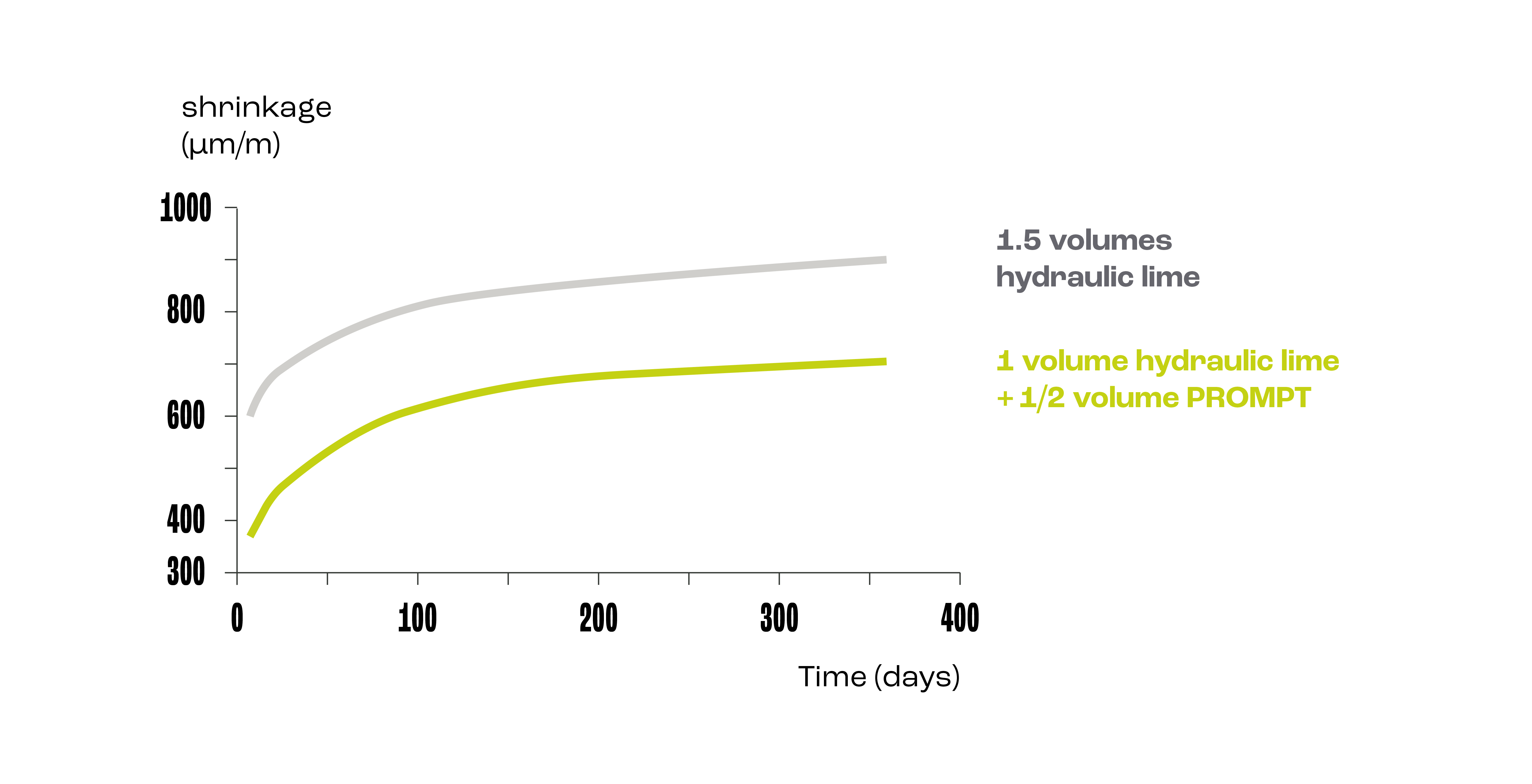
A minority proportion of natural Prompt cement compared to lime provides short-term strength to lime mortars and limits shrinkage without disrupting the breathable qualities and low modulus of elasticity of the walls.
Le ciment naturel Prompt, grâce à sa composition unique et son processus de fabrication spécifique, affiche un taux de retrait nettement inférieur par rapport à d'autres types de ciments.
Cette propriété est particulièrement bénéfique dans les applications où la précision et la stabilité dimensionnelle sont cruciales, comme la restauration de bâtiments historiques ou la réparation de structures délicates.
En minimisant le retrait, le ciment naturel Prompt assure une meilleure adhérence à la surface appliquée et réduit le risque de formation de fissures, améliorant ainsi la durabilité et l'esthétique des constructions. Cette faible propension au retrait, combinée à sa prise rapide et à sa résistance aux conditions environnementales, fait du ciment naturel Prompt un choix privilégié pour des projets exigeant à la fois fiabilité et préservation esthétique.
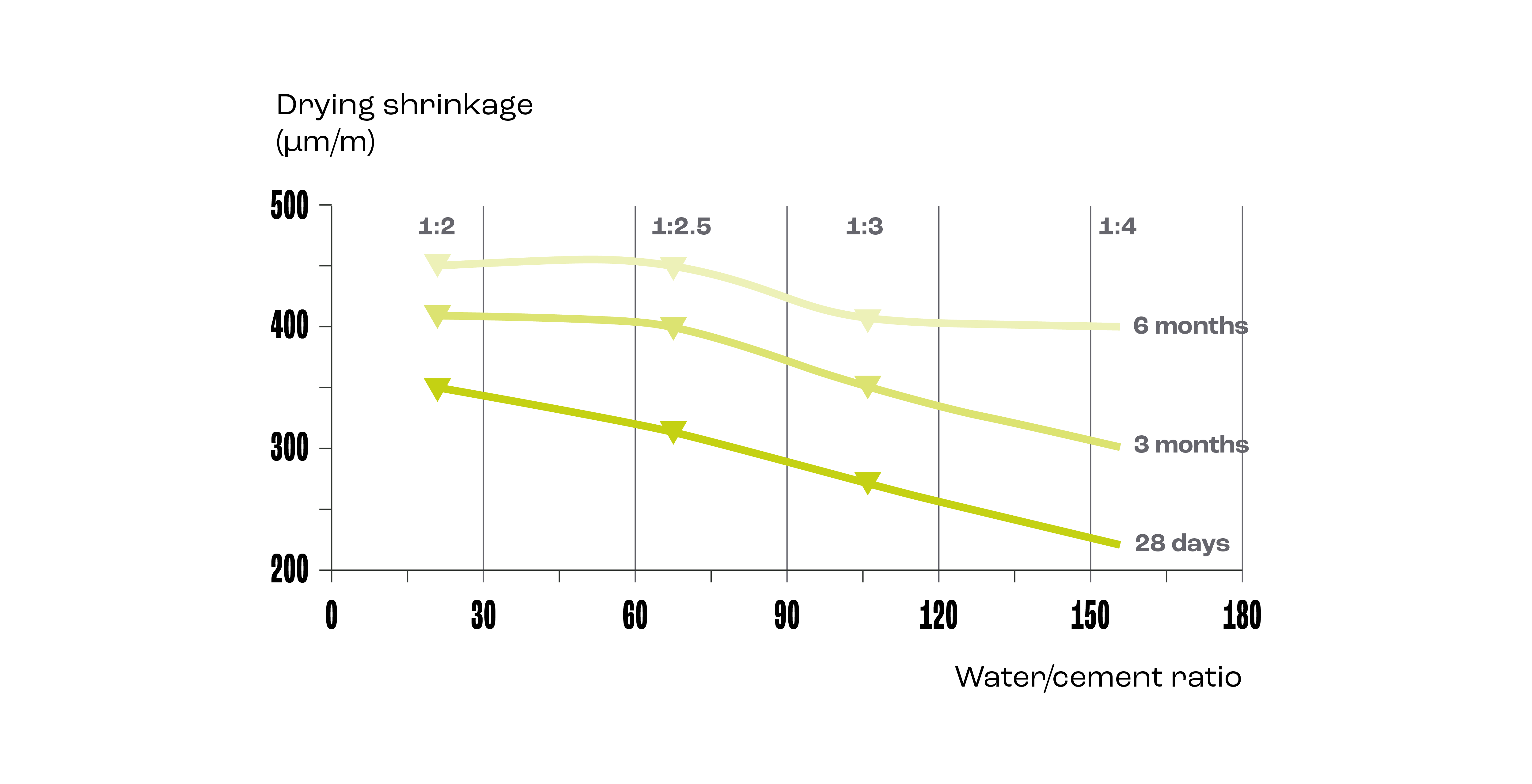
Natural Prompt cement and Portland cements show different drying shrinkage behaviours, which derive from their respective mineralogical composition. Prompt is obtained from a single argillaceous limestone rock fired without any addition, while Portland cements combine clinker and variable secondary constituents (slag, ash, limestone, pozzolans). These differences in composition explain why each cement is preferred for certain fields of use: Prompt for the restoration of built heritage, where compatibility with ancient substrates is sought, and Portland cements for standard reinforced concrete structures.
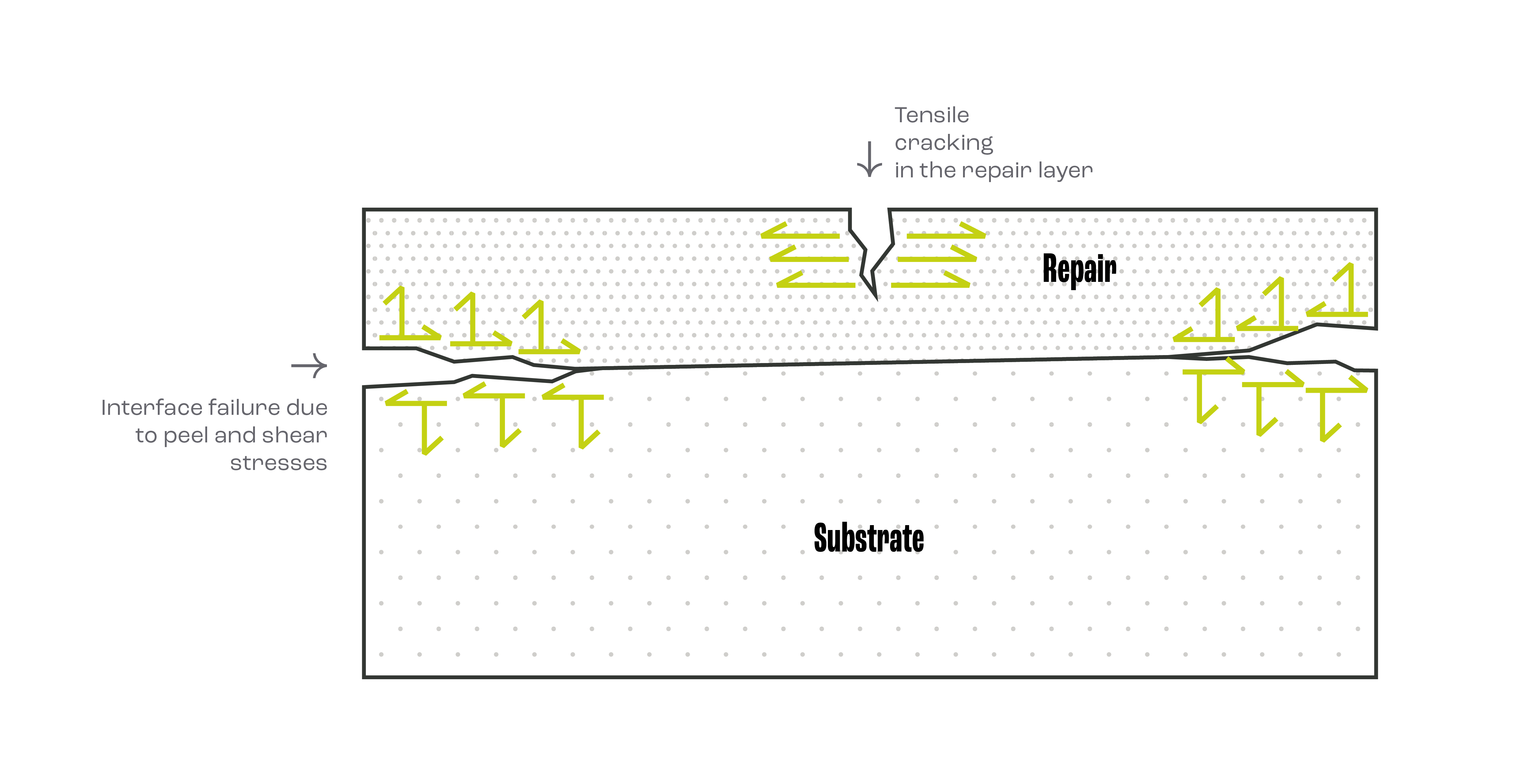
Mortar cracking on drying is mainly caused by hydraulic shrinkage: the material contracts as it loses its mixing water. Natural Prompt cement limits this phenomenon thanks to its unique composition and rapid setting, which reduces the time during which the mortar is exposed to evaporation. Cracking can however appear if the substrate is not damped, if there is excess mixing water, or if the mortar is reworked after the start of setting.
Yes, and this is one of the major benefits of this combination. In a smaller proportion than the lime, natural Prompt cement gives the mortar its short-term strength while limiting overall shrinkage. The lime retains its breathability qualities and its low elasticity modulus, ideal for old walls. This mix is particularly recommended for stone masonry repointing and the restoration of old buildings.
Natural Prompt cement has a low drying shrinkage. When cracks appear, they are generally due to insufficient application thickness, an undampened substrate, excess mixing water or significant thermal variations during setting. Re-mixing after the start of setting is also a frequent cause of cracking. Respecting the recommended dosages and the implementation conditions prevents the vast majority of these defects.
Yes, natural Prompt cement is suitable for thin-layer applications, this is one of its qualities on finishing works. Its low shrinkage limits cracking in finishing renders and localised repairs. For thicknesses below 5 mm, prefer fine sand (0/1 or 0/2 grading) and a cement-rich dosage. For very thin layers, application as a pure paste with a little fine sand is preferable to ensure cohesion.
Natural Prompt cement shows a drying shrinkage significantly lower than that of standard Portland cements. This property is explained by its unique mineralogical composition, rich in calcium sulpho-aluminates whose hydration reaction partially compensates the shrinkage phenomena. It is this characteristic that makes it suited to the restoration of built heritage, where compatibility with old substrates and the absence of shrinkage tensions are essential.