PROMPT natural cement is one of the hydraulic binders.
Its properties and characteristics make it an ideal choice for underwater interventions.
It can be used in mortar, concrete, or pure paste, depending on the application.
The dosage of PROMPT natural cement, along with its quick setting, allows for efficient and durable interventions while avoiding the washing out of mortar or concrete due to water currents.
- Pour l’imperméabilisation des bassins, réservoirs, tuyauteries, cuves, fosses, caves humides ou ruisselantes et le reprofilage des ovoïdes
- Pour la réparation des bassins, réservoirs et piscines : reprises d’enduits, réparation des fissures, traversées de cloisons, des bétons autour des pièces à sceller
- NB : il est préférable d’utiliser des sables fins [0/1- ou 0/2] pour ces ouvrages
- Pour la construction de batardeaux et les travaux dans les réseaux
- Pour tous types d’ouvrages immergés : semelles de murs, petits radiers, fonds de regards…
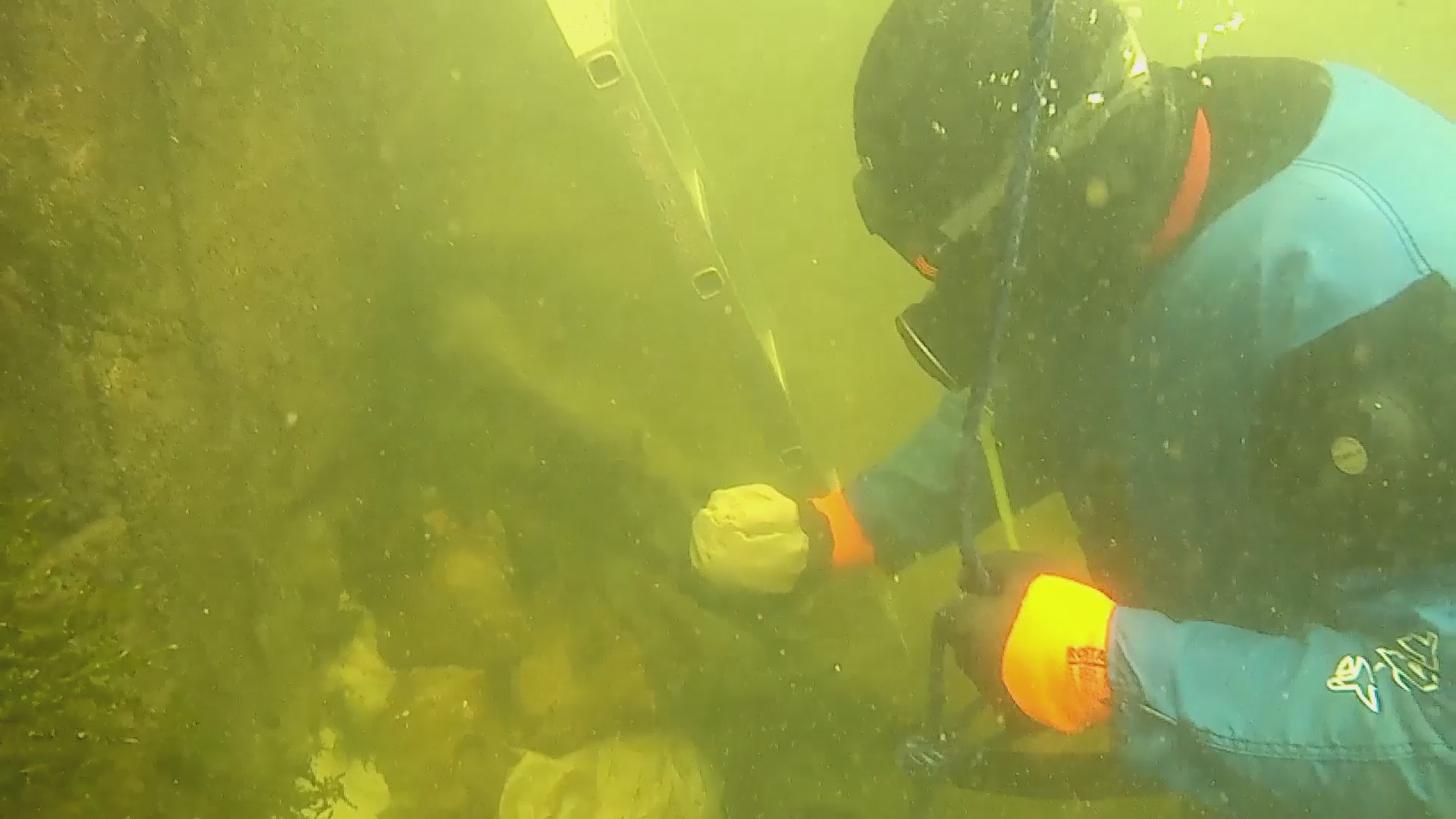
Pour l’aveuglement de voies d’eau et la réparation de fissures immergées uniquement.
Gâcher le ciment naturel avec de l’eau jusqu’à obtenir la consistance “mastic” et appliquer sur la zone à traiter pendant au moins deux minutes. Selon la dimension de l’aveuglement à réaliser, il est préférable d’appliquer plusieurs petites gâchées jusqu’à l’aveuglement complet en ayant pris soin de recouper la gâchée précédente afin de faciliter l’accroche.
Important : Le gâchage et l’application se font généralement à la main (le port de gants est obligatoire).
PROMPT natural cement is a hydraulic binder: its setting reaction is triggered and sustained by water, not inhibited by it. Its rapid setting is the key factor: the mortar gains sufficient strength before any current can disintegrate the fresh mix — this is known as washout resistance. Ordinary Portland cements, which set far more slowly, do not benefit from this natural protection in submerged conditions.
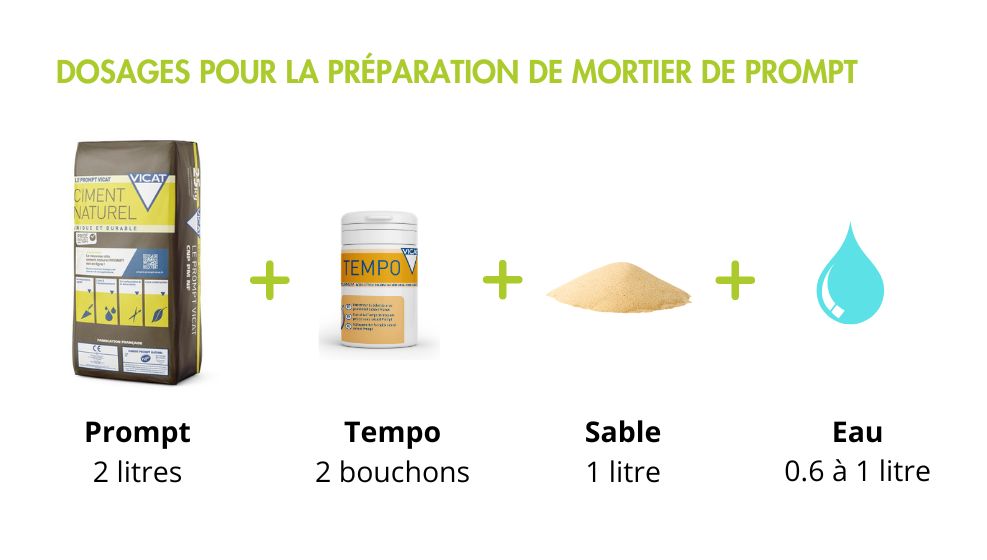
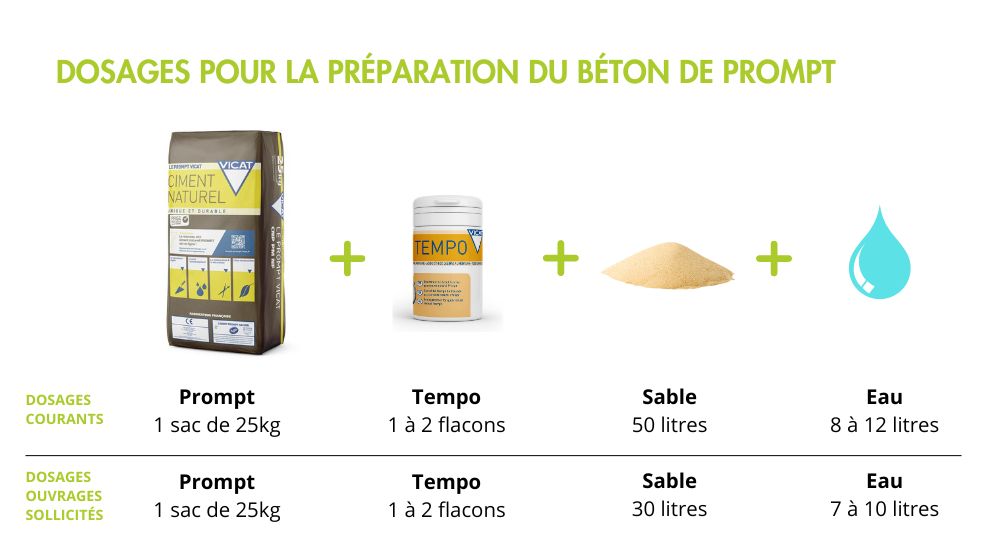
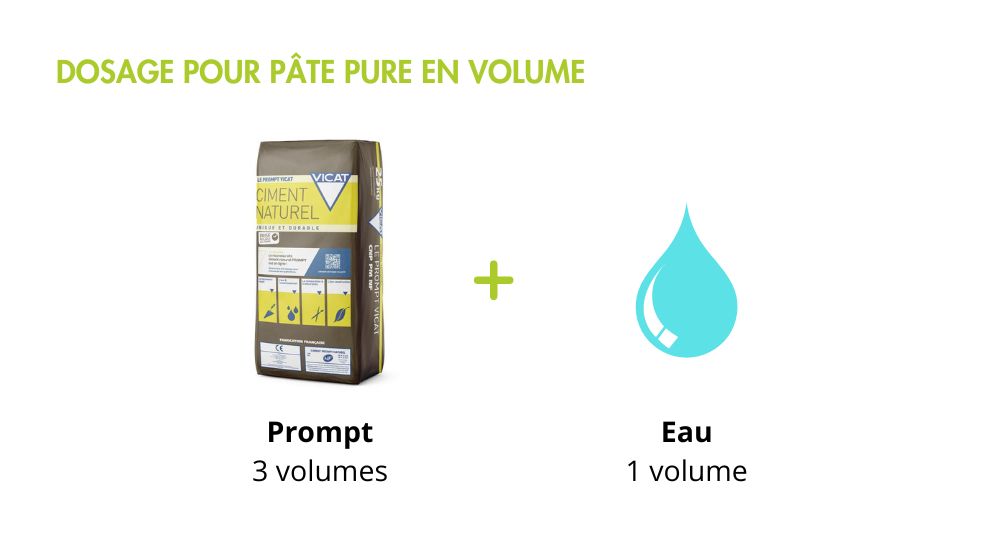
The three formulations serve distinct purposes. Mortar (PROMPT natural cement + fine sand 0/1 or 0/2 + water) is used for waterproofing surfaces and crack repair. Concrete (PROMPT natural cement + sand + aggregate + water) is suitable for submerged structural elements (footings, raft foundations, inspection chamber bases). Neat cement paste (PROMPT natural cement + water only, putty consistency) is reserved for plugging active water ingress — the only formulation that can be applied directly by hand over a leak.
The three formulations serve distinct purposes. Mortar (PROMPT natural cement + fine sand 0/1 or 0/2 + water) is used for waterproofing surfaces and crack repair. Concrete (PROMPT natural cement + sand + aggregate + water) is suitable for submerged structural elements (footings, raft foundations, inspection chamber bases). Neat cement paste (PROMPT natural cement + water only, putty consistency) is reserved for plugging active water ingress — the only formulation that can be applied directly by hand over a leak.
PROMPT natural cement is used in conditions ranging from damp or running water environments to fully submerged settings. For sealing under pressure (active water ingress), the neat paste technique allows direct intervention at the point of leakage. There is no inherent depth limitation for the material; constraints are related to site access and safety conditions.
The neat paste is applied by hand because it is the only way to maintain continuous pressure and shape the plug during setting. However, fresh cement is alkaline and can cause chemical burns on the skin upon prolonged contact, particularly in aqueous environments. Wearing waterproof gloves is therefore mandatory throughout the minimum 2-minute application period and during successive batches.
Mix PROMPT natural cement with water to achieve a putty-like consistency. Apply by hand while maintaining continuous pressure for at least 2 minutes. For larger openings, work in small successive batches: each new application must overlap the previous one to ensure bonding. Do not attempt to seal everything in a single oversized batch — the rapid setting does not allow time to shape a large volume in one go.
Yes, this is one of its most common applications. Applied as a render on the walls of a damp or seeping cellar, PROMPT natural cement creates a waterproof barrier resistant to hydrostatic pressure. The rapid setting allows work even on wet or slightly oozing substrates. For very damp cellars, fine sand (0/1 or 0/2) is recommended, working in several passes starting with the driest areas.
PROMPT natural cement develops its mechanical strength from the moment of final set, including when placed in submerged conditions. Setting and hardening underwater do not diminish the final performance — water is the reagent for hydraulic setting, not a degradation factor. The material continues to gain strength beyond the initial set.